





Coal Mining in Castlecomer
The Castlecomer Plateau
Mining in Castlecomer began in the mid 17th Century with the extraction of iron ore. Huge areas of oak woodland were cleared to feed the smelting furnaces. At this time coal was not used as the process of coking coal for the furnaces hadn’t been developed yet. Iron was generally found as nodules known as iron balls in the shale deposits of the area. In later years coal deposits were found beneath the shale and these were to form the basis of the coal mining industry in the area which lasted for over 300 years. In the mid 17th century, Christopher Wandesforde, from Yorkshire was invited to Ireland by the Lord Lieutenant and granted a large estate in Castlecomer which included the Castlecomer coalfield. The Wandesforde family were responsible for the opening up of a number of coal seams and over time earned quite a large fortune from coal mining. In the early days land was leased out to middle men who employed miners to dig the coal. Overseers were employed to watch for illegal mines but some people managed to work small scale mines for a time by keeping the entrances hidden.
The Leinster Coalfield is centred on Castlecomer and extends into counties Laois and Carlow. The coal seams were often quite narrow but the coal itself was very high quality anthracite with a low sulphur content. There were three separate seams worked in the area at different times with a number of pits operating in each seam.- The Old Three Foot Seam - The first coal seam to be worked in Castlecomer, the Old Three Foot seam was found at depths of between 15 and 45 meters. This seam was worked using Bell Pits until 1815 when the coal was exhausted.
- The Jarrow Seam - Once the original coal was exhausted, the Wandesforde family enlisted the help of geologists to search for more coal and they located the Jarrow seam. This was in the shape of a horseshoe with coal up to 1.2m thick in the centre and thinner at the edges.
- The Skehana Seam - In the early 20th Century, a deeper seam was discovered at Skehana, which contained some of the best quality anthracite in the world. A number of pits were opened up in the Skehana seam including the Deerpark. The Deerpark was the largest and deepest of the pits in the area and was the last to close, remaining open until 1969.
Early Mining Methods
In the early days mining was carried out through the use of bell pits. Two shafts were sunk up to 150 feet (45 metres) apart and joined by a connecting tunnel for air. The miners would then go down the shaft and start digging out the coal on either side of the connecting tunnel with pillars of coal left in place to support the roof.
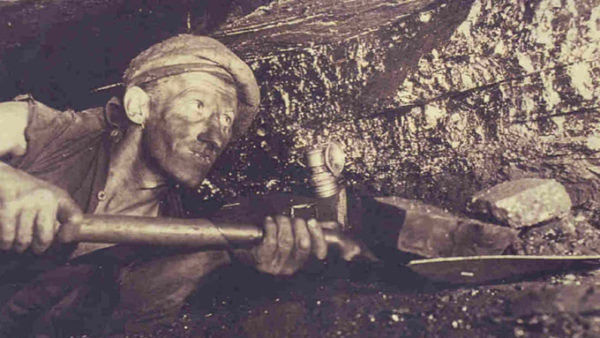
Because the coal seams were often quite thin, many of them only 18 inches (45cm) thick, the coal miners often had to work on their sides ‘colliering’ or digging out coal from the coalface with a pick for up to 8 hours per day. The coal was then brought to the bottom of the shafts by men dragging sleds filled with wooden boxes of coal, and winched to the surface by hand. The coal sleds were pulled using a ‘Gurl and Swivel’, which consisted of a heavy leather belt worn around the waist with a hook attached to the sled. In later years, mining became more mechanised with the use of coal cutters and electric conveyor belt and rope systems for transporting the coal. Because of these improvements and the addition of pumps for removing water from the mines and fans for circulation of air, mining could be carried out on a larger scale.Wandesforde Family
When Captain R. H. Prior-Wandesforde inherited the estate in the late 19th Century, the family owned thousands of acres of woodland in the area. In previous years, the mines had been operated by master miners who leased the mines from the Wandesforde family, but ‘The Captain’ took personal control of the mines. He introduced many improvements in the mine workings including overhead ropeways to transport the coal to the Deerpark railway depot. He also established the Castlecomer Basket Factory, the Castlecomer Agricultural Bank and the Colliery Co-operative Society and built a number of housing schemes for the mine workers.Unions
Conditions in the coal mines were very difficult and many workers were dissatisfied with their pay, housing conditions and lack of washing facilities. In the 1920s, Nixie Boran and some of the local miners formed a branch of the ‘Revolutionary Workers’ Group’. After a visit to Russia, for which he had to be smuggled out of the country, Nixie Boran returned to Castlecomer and the ‘Castlecomer Workers’ Union’ was formed and later renamed as ‘The Irish Mine and Quarry Workers’ Union’. The union sought to improve pay and working conditions for the miners but was strongly opposed not just by the mine owners but by many local people, including the clergy, because of its supposed communist connections. Over the years, there were many strikes and disagreements with management, but these eventually led to improvements in pay rates, the introduction of showers and lockers and improvements in mechanisation and working conditions.Dangers
Working in the coal mines could be very dangerous and many people lost their lives. The coal was taken out the mines on carts which travelled on a tracks attached to a continuous rope system. The system needed to be carefully managed and there was potential for great disaster if a chain snapped and a cart got loose and travelled back down the mine to collide with those behind. The coal miners’ lungs were often very weak as a result of breathing in the coal dust underground and the coal miners’ disease Pneumoconiosis was common. The mines did however, have one major advantage over other coal mines in Europe. Because the anthracite produced no methane gas, there was no danger of explosions and naked flames could be used for light.Conditions
For those men working in the coal mines, life was often difficult. Pay and housing conditions were very poor and for many years the miners did not have coal to burn in their own fires. Instead they used the coal dust which was known as ‘culm’ and mixed it with yellow clay to burn in the fire. Until 1939, there were no washing facilities at the mines so miners would have to walk home in their dirty and often wet mining clothes and try to dry them by the fire at night. There were no toilet facilities so miners would have to use the disused mine roads which were known as the ‘gobbin roads’.The mines were also full of rats. Because of the rats, most miners used to keep their lunch in tin boxes known as ‘piece boxes’. Although the rats could spread disease, they were also useful in cleaning out the ‘gobbin roads’ by eating the human waste. The rats would leave the mine in advance of a water leakage or other disaster, thus alerting the miners to the danger.
For more information on Coal Mining in Castlecomer contact Castlecomer Discovery Park
For more information please see: